Household Agent Started With Codex
I started using Codex as a financial planner inside another project. It was weirdly useful. I could give it enough context, look at a plan, then keep asking the next question against the same assumptions.
But it was also Codex. I needed to know how to drive a coding agent, what context to give it, and when a tidy answer was too tidy to trust. Fine for me. Not a sensible product requirement for someone who just wants to understand their money.
That is how Household Agent started.
Money2Time does something I like: it turns a price into hours of work. One narrow question, made obvious. That is closer to what I want: a financial tool that knows the job it is trying to do.
But the part I keep thinking about is not even the model. It is where the agent lives.
When I run Claude Code, Codex, or Pi locally, I am running a session around a workspace. If I want it to keep listening after I close my laptop, something needs to stay on: a Mac Mini, a VPS, whatever. Hermes gets much closer to a personal agent: it keeps session history, memory, and a messaging gateway. Hermes still needs a machine somewhere.
Cloudflare Agents feel different in this particular case. An agent can run when a message or scheduled task arrives. Its compute can scale down to zero while it is idle; the Durable Object SQLite state is still there when it wakes again. I do not need to keep a terminal session running just so it can remember.
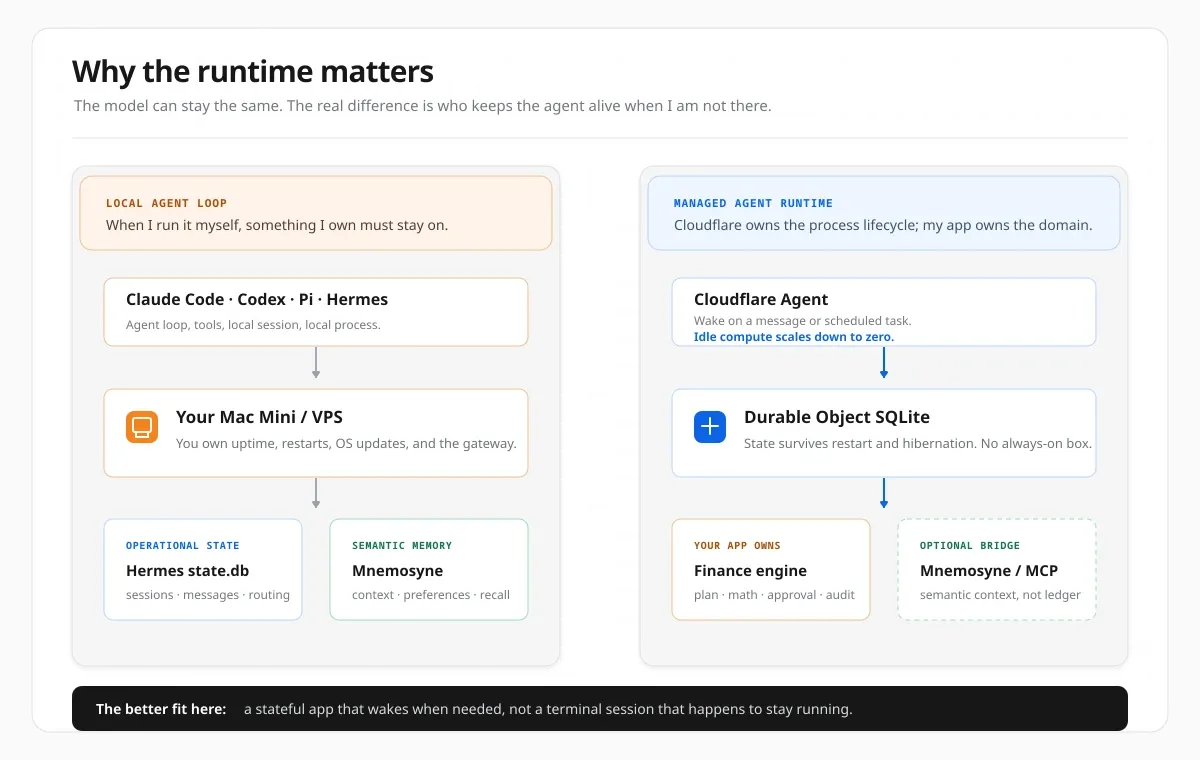
This is not a claim that Cloudflare Agents replace Claude Code, Codex, Pi, or Hermes. Those are excellent when I am the person operating them. What I want here is more public-facing: something even my ahma can use without knowing what a coding agent, a Mac Mini, or a server is.
The model can still be frontier-grade. Cloudflare Agents only changes the runtime around it. The terminal session can disappear. The plan should not.