06 / UNDER THE HOOD
Let Code Shortlist, Let the Model Pick
We have an internal app that keeps track of documents and money: contracts, payment requests, vendor invoices, bank statements. A lot of its work is matching. Which invoice does this bank line pay? Is this the same invoice the email talked about? Which vendor is this row in the spreadsheet?

The first version did this with rules. A payment reference in the memo, an exact amount, a vendor name spelled the way we expected. Rules work until a memo looks a bit different. Then nothing matches, and the fix is me adding another rule. Rules can’t learn, so I kept stepping in. That’s annoying, because I’m consistently out of tokens.
Then OpenAI shipped the Decisions API, and I kept thinking about how to make use of it. I think it’s a good fit for “system one”: the fast, gut answer to a closed question, not the slow reasoning. This demo is what got me thinking:
Decisions API demo on X
So now the rules still run first, and for what’s left we ask a decision model.
A closed question, not extraction
POST /v1/decisions takes one input and up to 400 questions about it. Each question is a choice question with its own list of allowed answers. The answer is the picked value and a confidence between 0 and 1.
That shape is the whole point. The model can’t invent an invoice. It can only pick one we put on the list, or pick none. Here’s one bank line, with made-up data:
Code builds the list: same direction of money, an amount close enough, dated around the line. The model reads the memo, which is often Vietnamese without accents and cut short, and picks.
An answer below 0.6 confidence is thrown away. I’d love to say 0.6 came from testing. It didn’t, I picked it. What keeps that honest is that a pick at 0.6 or above still isn’t a link. It’s saved as a suggestion, and a person accepts or rejects it.
The Workflow around it
Every document that comes in gets its own Cloudflare Workflow instance, DocumentIntake. Emails reach it through Email Routing, which hands each one to a Worker. Uploads from the app start one too.
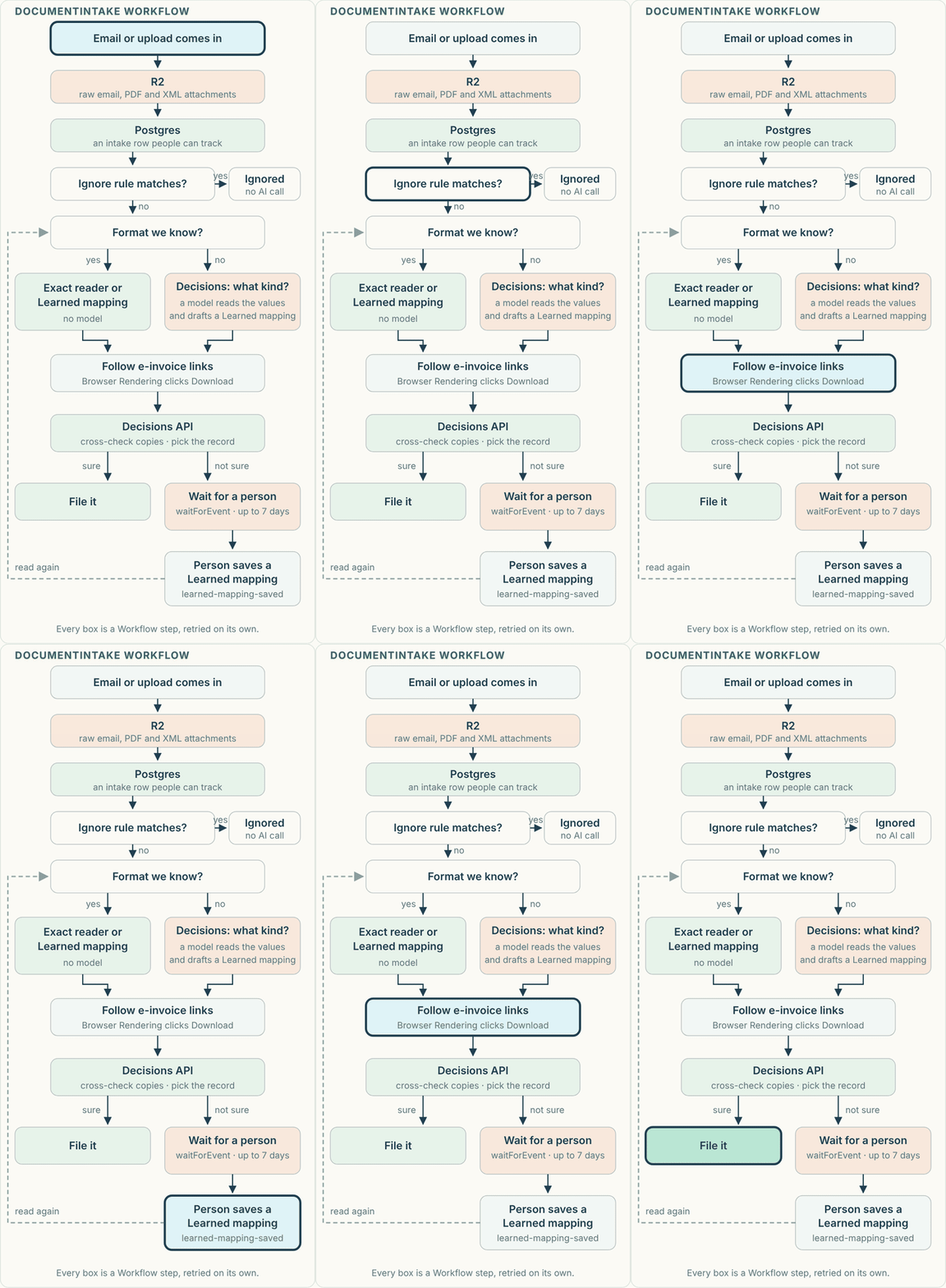
One more detail: some Vietnamese e-invoice emails don’t attach the XML, they link to a portal. For portals that only work in a browser, Browser Rendering opens the page and clicks the download button.
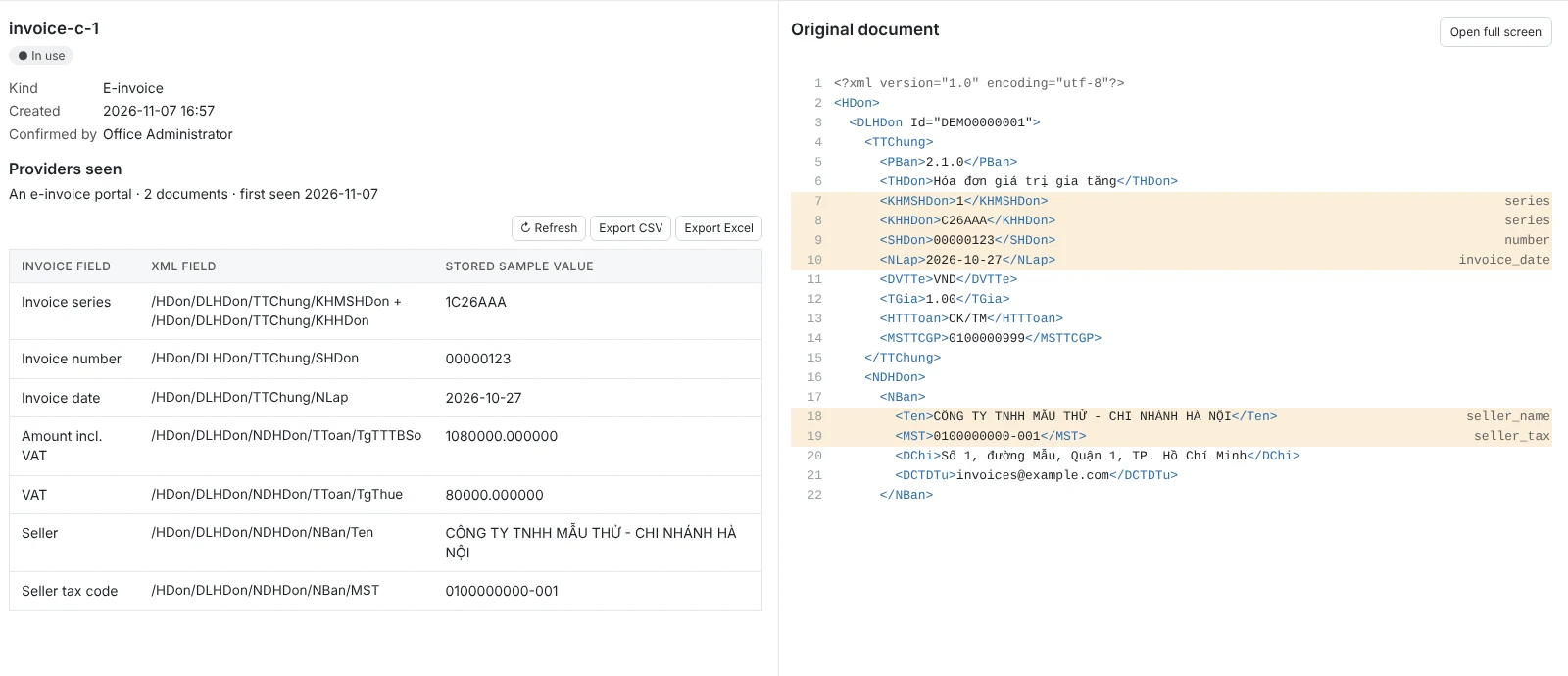
The waiting is where the rules learn. When the XML is in a format no reader knows, the model drafts a Learned mapping and the Workflow calls step.waitForEvent for learned-mapping-saved, for up to 7 days. A person checks the draft and saves it. The event comes in, the Workflow reads the document again with that mapping, and settles. The next invoice in that format gets read by the mapping, no model and no me.
While it waits it doesn’t run anything. And each box is a step.do, so if the Decisions call fails, the Workflow retries that step. It doesn’t download the file again or write a second row.
Bank statements get the same idea in a BankMatch Workflow: exact references in SQL, then the Decisions call from the section above, then it emails the reviewers and waits for review-done, reminding them every 3 days, at most 3 times.
Checking a reading against every copy
An invoice often arrives as more than one copy: the email body, the PDF, and the XML from Vietnam’s e-invoice system. When we read values out of one of them, we want to know if the others agree. With made-up data:
| Value read | XML | ||
|---|---|---|---|
Invoice number 563 |
same | same | same |
Date 10/11/2026 |
same | absent | same |
Total 15,840,000 |
same | different (15,480,000) |
same |
Each copy goes in as its own message, and each value gets one question per copy: same, different, or not shown? With two copies or more there’s one more question: are these the same document?
It’s not one API call per field. The whole table is one Decisions call per document: each copy is a message, and every value and copy pair is its own question in the same request. For the table above that’s 9 questions plus one:
input:     [task], [copy 1: XML], [copy 2: email], [copy 3: PDF]
questions: c1_invoice_number   same | different | absent
           c2_invoice_number   same | different | absent
           c3_invoice_number   same | different | absent
           c1_date ... c3_total
           same_document       yes | no
One request can hold up to 400 questions, so a normal invoice never needs a second call. Clef takes 64 per call, so on the fallback a big one is split.
Before, it was one yes/no question per value with all the copies joined together. The model could say “no”, but we couldn’t tell which copy disagreed.
The confidence for a value comes from checkFromCopies:
const best = (says) => Math.max(0, ...sources.filter((s) => s.says === says).map((s) => s.confidence));
return { ...d, confidence: best("same") * (1 - best("different")), sources };
The surest copy that shows the value, times one minus the surest copy that shows another one. A copy that doesn’t show it is neutral, because an email often doesn’t name an amount. In the table above, the total would go to a person.
One case: the XML had invoice number 00000563. Another copy wrote 563. The model said “different”. Now each question names the other ways a value can be written, and says leading zeros, a day-first date and thousands separators don’t make it another value.
Clef as the fallback
When the OpenAI call fails, or we’re out of credits, the same questions go to Clef, Cloudflare’s decision model on Workers AI. I added it to save money, not after a benchmark. The adapter in decisions.ts joins the messages into one text, sends 64 questions per call, and records the model on each answer, so a person can see which one picked.